Talk Overview
Recent improvements in single molecule technologies have enhanced our understanding of nanomachines; the cells’ tiny engines. Dr. Taekjip Ha explains how scientists have used fluorescence microscopy, in combination with other tools, to study nanomachines. For example, by tagging the protein myosin with a fluorescent dye, his laboratory was able to provide conclusive evidence that this protein does not “crawl”, but “walks” along actin. Ha explains the basis of Fluorescence Resonance Energy Transfer (FRET) and how it can be used to measure conformational changes within a protein (intramolecular) or movement between two molecules (intermolecular).
In his second lecture, Ha shows the value of combining FRET with optical trapping. An optical trap uses focused light to “grab” a particle and “pull” allowing scientists to measure the force required to move a molecule. Ha’s lab used this combination of technologies to study the dynamics of nucleosome binding to DNA. His lab was able to show that nucleosome “unwrapping” from the DNA is asymmetrical, unidirectional, and sequence dependent. Combining FRET and optical trapping technologies with other tools, like whole genome sequencing, scientists can predict novel areas of high transcriptional activity.
In Part 3, Ha explains how his laboratory used optical tweezers (a variation on an optical trap) to study helicases and their regulation. Their data confirmed that the closed conformation of the 3’-5’ DNA helicase is the active form of the enzyme. They combined optical tweezers with FRET to further understand the role of the open conformation of the helicase. Ha encourages scientists to continue combining these single molecule technologies to better understand nature’s complex nanomachines.
Media
Developing Single Molecule Technologies to Study Nanomachines
Speaker Bio
Taekjip Ha
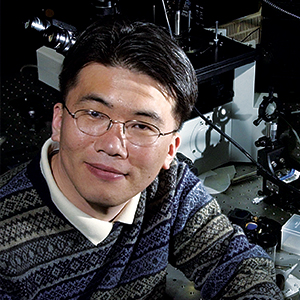
When Taekjip Ha moved from Korea to the United States to begin graduate school, he also transitioned from being a theoretical physicist to being an experimental biophysicist. During his last few months of graduate school, he developed fluorescence resonance energy transfer, or FRET, a technique he has since used to investigate many questions in cancer… Continue Reading